

Explore RIFT.

22 pages
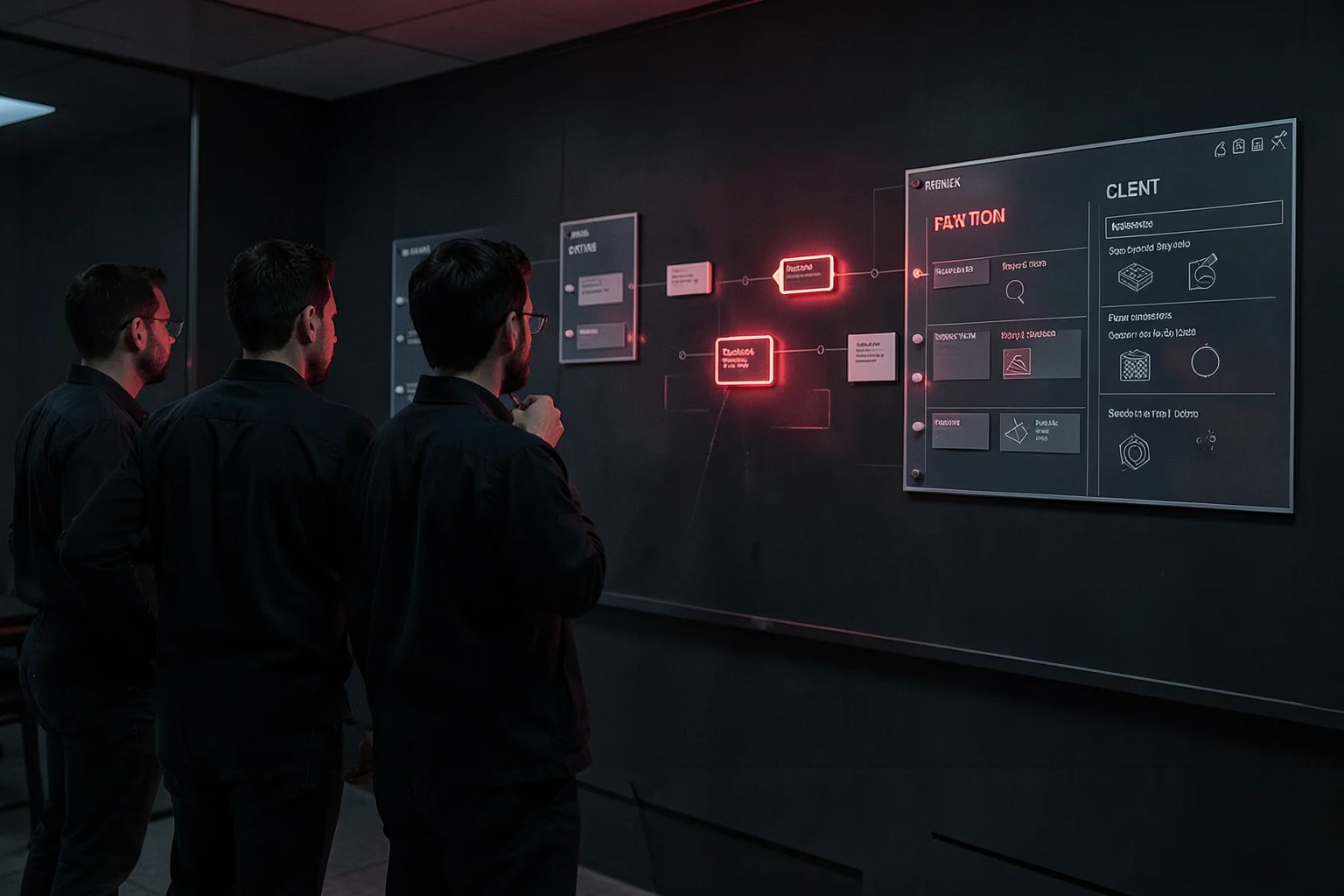
Cinematic illustration of an analyst in a cyber defence operations room.
Authorised red teaming / Security assessment

ASSUME
NOTHING.

Put your security assumptions under pressure.
Connect the gaps you find to the decisions that matter.

01 / DefineA question worth testing.

Agree the decision, the boundary and the evidence you need.

02 / ObserveA result with context.

Separate verified observations from assumptions and untested areas.

03 / ImproveAn owner for the next step.

Turn the finding into a change that can be checked.

RED TEAMING / Objective-led exercisesASSESSMENT / Bounded technical evidenceVALIDATION / Defensive improvement
01 / Choose the right question

Security is a system.
Test how it holds together.

A weakness, a missed signal and an unclear escalation are different problems. They need different questions. The RIFT approach connects technical assessment with the people, evidence and decisions needed to act on the result.

Assessor examining a network path during an illustrative controlled exercise.Adversary-led / Red teaming

Challenge the response.
Not just the perimeter.

Use an agreed objective to examine what happens between an adversary action and an organisational decision. Scope, observation and control are part of the exercise from the start.

Inside a red-team engagement ↗


Laptop, test device and isolated network equipment on an assessment workbench.Technical assessment

Find the condition.
Explain the consequence.

Assess a defined application, service or environment and give the owner evidence they can use.

Explore penetration testing ↗
Two analysts comparing an exercise event with defensive observations.Defensive collaboration

Make both sides
better informed.

Connect a selected scenario to telemetry, detection logic and the investigation that follows.

Explore purple teaming ↗
02 / Explore the evidence chain

Different questions.
Different proof.

Choose a question to see the evidence an engagement should establish—and the conclusions it should avoid.

Assurance model / Illustrative
01Defined asset
02Observed condition
03Verified finding
A QUESTION → AN OBSERVATION → A DECISION
The assessment question

What is exposed, and why does it matter?

A bounded assessment connects an observed condition to its preconditions and consequence. It should distinguish what was verified from what remains a hypothesis.

Evidence to establish

Asset identity, agreed access, reproducible observation and the conditions required for the result.

Useful output

A finding that an engineering owner can understand, prioritise and verify after a change.

What it does not prove

A finding describes the tested conditions. It does not establish that every asset or path was covered.

Conceptual model only. This explorer does not scan, connect to or assess any system.

The RIFT principle

A report is not the finish line.
A better decision is.

Evidence needs context, an owner and a useful next step. A finding without its conditions can be misunderstood. A fix without verification can leave the original question unanswered. Keep the chain intact.

Illustrative evidence-handling desk with a timeline, diagram and storage device.
03 / Control the engagement

Deliberate scope.
Defensible evidence.

Good assessment starts before testing. Establish who owns the environment, what work is authorised and how the team will pause if conditions change. Keep those decisions visible through reporting and follow-up.

Read the complete engagement method ↗
04 / Field notes

Read before
you run the exercise.

Complete guides for choosing the assessment, defining its boundaries and making the results useful to the people who own the next decision.

Three assessment views comparing attack paths, application boundaries and detection timelines.
FIELD NOTE / 01

Choosing an assessment

Red teaming, penetration testing and purple teaming answer different questions. Compare the evidence each can provide before selecting the label.

Read the complete guide ↗
A defined scope marked around part of an illustrative network map.
FIELD NOTE / 02

Scoping an exercise

Translate a broad concern into an objective, asset boundary and evidence threshold. Bring operational owners into the conversation early.

Read the complete guide ↗
Security and engineering owners reviewing evidence and assigning follow-up work.
FIELD NOTE / 03

From evidence to action

Make the finding understandable, assign ownership and agree how the change will be verified. Keep uncertainty visible throughout.

Read the complete guide ↗
The next useful question

What do you need
the evidence to tell you?

Start with the decision, the environment and the constraints. Create a scope brief you can download, review with your team and refine before any engagement is considered.

Build your scope brief ↗
RIFT / Adversary assurance
Enter

RIFT

Click anywhere to enter with sound.

Assume nothing. Question the perimeter. Prove the response.